

Dr. Gerlinde Verhaeghe
Visiting scholarVisiting scholar
Rheinsprung 9/11
4051 Basel
Schweiz
Curriculum Vitae
Dr. Gerlinde Verhaeghe currently is a postdoctoral researcher at eikones – Center for the Theory and History of the Image. Her research project “Domesticating Fascism: Women Shaping Domestic Cultures, Design and Aesthetics in Fascist Italy” is supported by the SNF Return CH Postdoc.Mobility Fellowship. It follows two research stays in Italy, at Politecnico di Milano and Politecnico di Torino, during which she examined the activities and exhibitons related to the domestic by Turin-based women’s association Pro Cultura Femminile in the interwar period.
Previously, she held research fellowships at the gta – Institute for the History and Theory of Architecture, the Canadian Centre for Architecture and Istituto Svizzero in Milan. Her doctoral thesis in architectural history at ETH Zurich (2024) examined the private interiors of Italian architect and designer Carlo Mollino from the perspective of the cabinet typology (1935-1945).
Before her doctoral research, Gerlinde Verhaeghe was a scientific assistant at KU Leuven. She has contributed to the public architectural and design discourses through writing, curatorial and editorial work. Her articles and reviews on furniture, interior design and architecture appeared in A+, aer, Scroope, Trans, Oase and SRSA – the journal of the Italian Association for the History of Architecture. Her research interests lie at the intersection of domestic architecture, cultural-, media- and gender studies, with a focus on interwar Italy.
Current Project
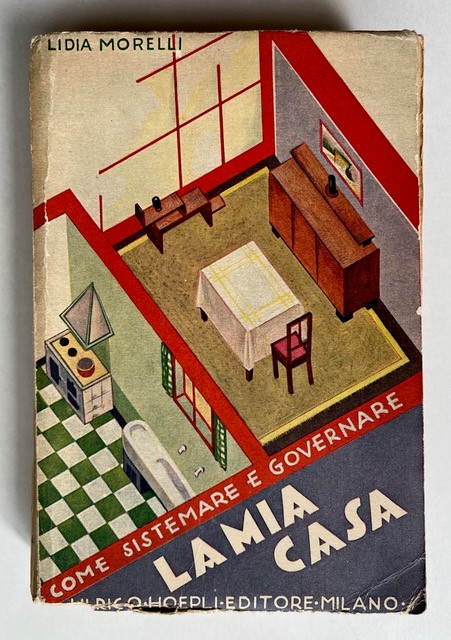
Domesticating Fascism examines the domestic sphere — to which the Italian fascist regime sought to confine women — from the perspective of architectural and design history. It proposes to view it as a space not only of reproductive but also of creative work for women during the fascist ventennio.
The domestic realm, traditionally associated with women, has for a long time been considered inferior and seen as an instrument for controlling and subordinating women. Historians of Fascism have explored how the patriarchal Italian Fascist regime subordinated women through an apparatus of policies, programs and institutions, seeking to incorporate them into a separate, domesticated sphere of culture. While the Fascist regime clearly applied boundaries to women’s scope of activities, tying them to the domestic realm, the cultural policies it developed to incorporate women into national life did also open possibilities, prompting women to shape domestic culture. Women artists, designers, writers and craftswomen produced a great variety of work in, on and for the Italian home, while negotiating their cultural production within the framework of the regime’s policies. The return phase of this project examines how women working in the realm of interior decoration, design and home furnishing domesticated Fascism, exploring specific ways in which women shaped the discourse on the domestic.
The project approaches cultural production with a focus on how, in interwar Italy, at a time of political upheaval, social, political and aesthetic forces intersected in the domestic at a time of political upheaval. From a historical perspective, the project aims to contribute to a better understanding of the role of women in Fascist Italy, and to a nuanced understanding of women's contributions to architecture, design, art, and the relation between domestic culture and politics in the broadest sense. With a view on present-day cultural and political developments, the project sets out to shed light on continuities and discontinuities between the ruptures and upheaval of the interwar period and today’s cultural controversies.
Quick Links